

Advanced threat detection
Understand how CounterCraft identifies and mitigates sophisticated cyber threats.
Deception strategies
Learn about the innovative deception techniques that set CounterCraft apart.
Specific threat intelligence
By monitoring and analyzing specific threat interactions with these deceptive elements, organizations can gather valuable threat intelligence, identify attack patterns, and enhance their security
Integration and implementation
Discover how easily CounterCraft can be integrated into your existing security infrastructure.
Frequently Asked Questions (FAQ)
A CISO should focus on how a tool detects real threats, not just how many alerts it generates. Key questions include what signals the tool relies on, how false positives are handled, and whether detection happens before or after damage occurs. It’s also important to understand deployment effort, integration requirements, and how the tool supports existing teams rather than adding operational burden. Find out how deception powers preemptive cybersecurity with a demo.
A vendor demo should show how the product behaves in realistic attack scenarios, not just dashboards and features. Ask what happens when an attacker moves laterally, uses valid credentials, or performs reconnaissance. You should also ask how the system proves malicious intent and how that intelligence is used in real incident response.
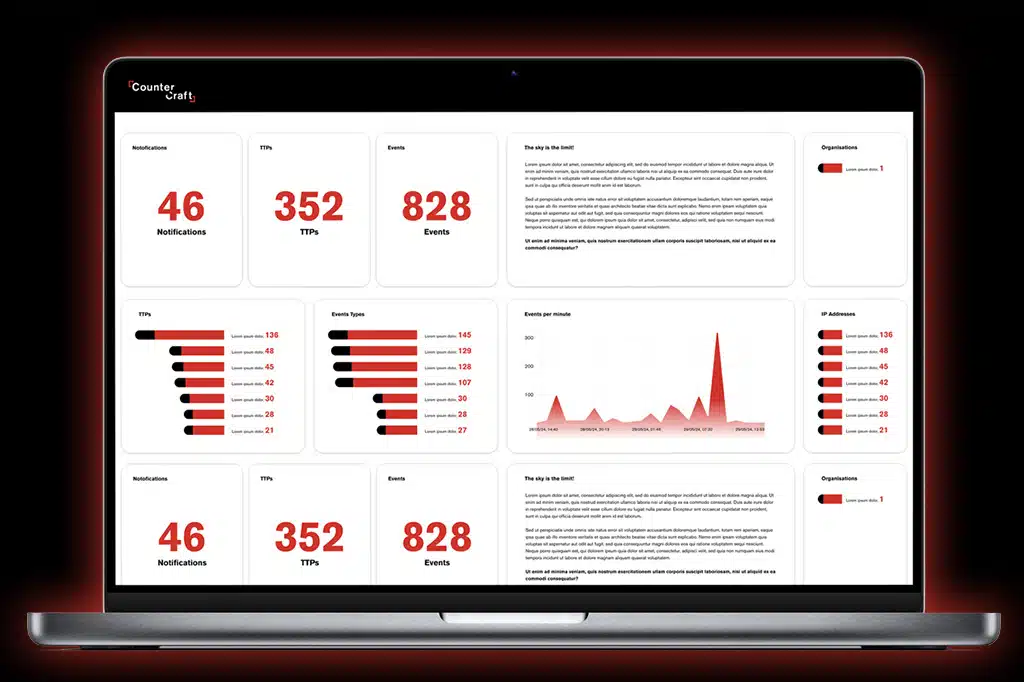
A CounterCraft demo is a guided walkthrough of how the platform detects attacker behavior using interaction with decoy assets. You’ll see how lateral movement, credential misuse, and reconnaissance activity are surfaced as high-confidence signals. The session is tailored to your environment and focuses on how teams use the intelligence operationally. Find out how AI-powered deception works with a demo.
Most demos take 30 to 45 minutes. They are most valuable when attended by CISOs, SOC leaders, incident response managers, or threat intelligence practitioners. These roles can best assess how the detection signals translate into real operational decisions.
Evaluation should focus on realism, signal quality, and operational impact. Ask how decoys are designed, what attacker behavior is captured, and how often alerts represent real malicious activity. You should also assess how quickly the platform can be deployed and how easily teams can act on the intelligence produced. You can find some questions here.
Many detection tools infer risk based on patterns, baselines, or known indicators. Deception technology detects threats when attackers actively interact with decoy assets that have no legitimate use. This provides direct evidence of malicious intent rather than probabilistic alerts.
CounterCraft is unique in that we can deploy in hours or days, not weeks or months like other vendors. Deployment time depends on environment size and complexity, but deception platforms are typically faster to deploy than endpoint or network agents. Because decoys do not sit in the production path, they can often be deployed without disrupting operations. Teams usually begin seeing attacker interaction shortly after deployment.
ROI comes from reduced investigation time, fewer false positives, and earlier detection of real threats. Tools that provide high-confidence signals allow teams to focus on confirmed malicious activity instead of alert triage. Over time, this reduces incident impact, analyst workload, and response costs.
You should understand your primary security challenges, such as lateral movement, insider risk, or ransomware exposure. Knowing where existing tools fall short helps guide more productive discussions. You do not need a full architecture diagram to start, but clarity on goals makes demos more valuable.